The Sermon on the Mount: The Kingdom Manifesto
Jesus's most famous sermon — the Beatitudes, salt and light, the Lord's Prayer and the golden rule. What it actually teaches, and why it still confronts us two thousand years later.
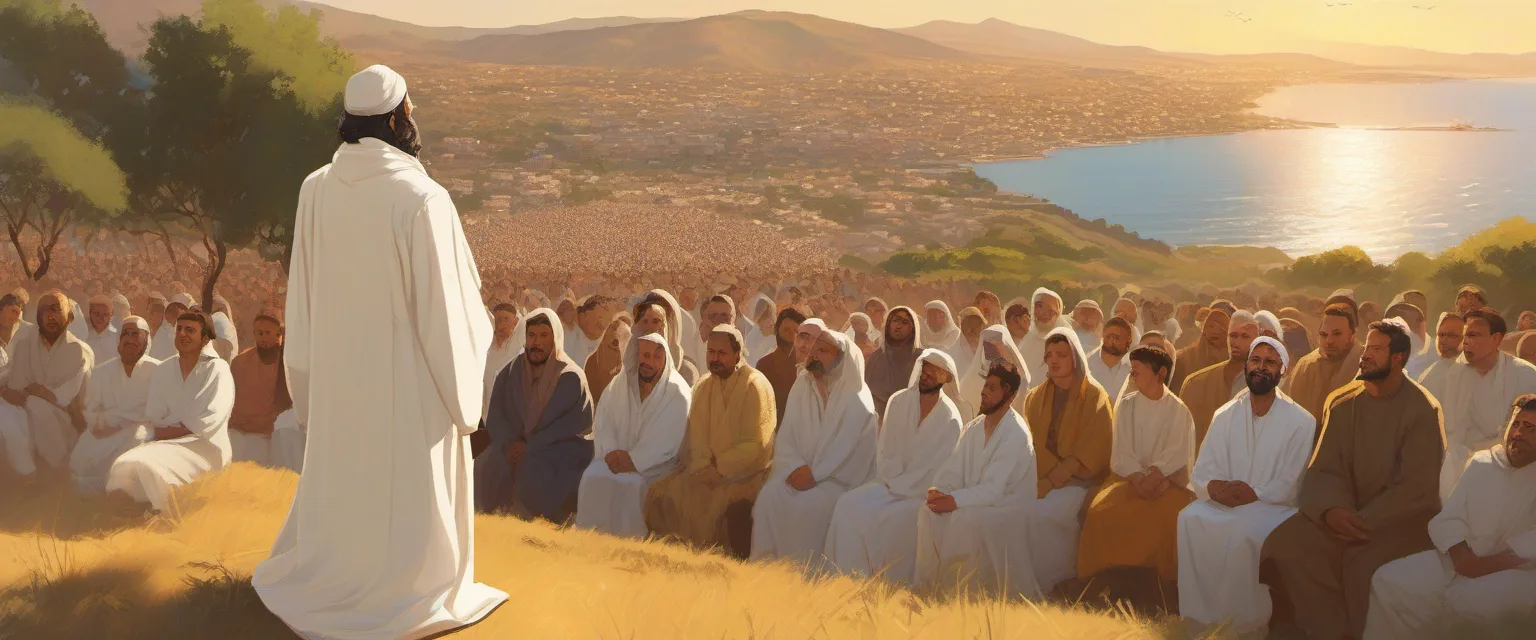
The most influential sermon ever preached took about fifteen minutes to deliver. No amplification, no stage, no manuscript — just a hill in Galilee, a crowd, and a teacher who sat down to speak. Matthew tells us Jesus “went up on a mountainside and sat down” before he began, because in the Jewish world sitting was the posture of authority. Rabbis sat to teach. Jesus sat to declare.
What follows in Matthew 5–7 is not a list of moral improvements. It is a manifesto: the constitution of a new kingdom, announced by its king, describing what life looks like when God actually rules.
The Beatitudes: blessings upside down
The sermon opens with nine blessings, and the first thing you notice is that they land on the wrong people. Blessed are the poor in spirit, the mourners, the meek, the hungry for righteousness. In the ancient world — and in most modern ones — those are the people you pity, not the people you envy.
The Greek word translated “blessed” is makarios, which describes a state of deep well-being, not a fleeting feeling. Jesus is not saying poverty and grief are good in themselves. He is saying that the people at the bottom are the ones the kingdom has come for, and that their position is not their final position. The kingdom turns the pyramid upside down.
Notice also that the Beatitudes are not commands. Jesus does not say “become poor in spirit.” He pronounces a fact: “theirs is the kingdom of heaven.” The sermon begins with grace — with what God is doing — and only then moves to what we are to do.
Salt and light
Immediately after the Beatitudes, Jesus turns to the disciples and tells them what they now are. “You are the salt of the earth” and “you are the light of the world” — not “you should try to be.” Salt preserves, seasons, and creates thirst. Light exposes and guides.
Two things are striking about the salt metaphor in Matthew 5:13. First, salt is only useful when it is different from everything around it — dissolved into the food, it disappears; kept in the shaker, it changes nothing. Second, Jesus takes the possibility of uselessness seriously: salt that “loses its saltiness” is thrown out. The kingdom people are to be in the world the way salt is in food: fully present, fully different, changing what they touch.
“You have heard that it was said… but I tell you”
The heart of the sermon is the six antitheses in Matthew 5:21–48. Six times Jesus quotes the tradition — “You have heard that it was said…” — and then overrides it with his own authority: “but I tell you.”
This is the most audacious thing in the sermon. Rabbis of the day cited earlier rabbis. Jesus cites himself. He does not attack the Law of Moses; he goes deeper than it. The law said do not murder; Jesus says do not even nurse the anger that feeds murder. The law said do not commit adultery; Jesus says do not feed the lust that starves faithfulness. The law regulated divorce and oath-taking; Jesus raises the bar to covenant fidelity and plain honesty.
The pattern is deliberate. The kingdom is not about external compliance; it is about internal transformation. A heart changed by grace produces behavior that no law could ever compel from the outside.
The Lord’s Prayer
In the middle of the sermon, Jesus gives his disciples a prayer — Matthew 6:9–13. It is compact, and every line is a kingdom commitment:
- Our Father — intimacy, but also family: not “my” but “our.”
- Hallowed be your name — the first request is for God’s glory, not our needs.
- Your kingdom come, your will be done — on earth, as in heaven. Not escape from the world, but transformation of it.
- Give us today our daily bread — dependence, one day at a time.
- Forgive us our debts, as we also have forgiven — the only request with a condition attached.
- Lead us not into temptation, but deliver us from evil — honesty about our weakness.
Jesus immediately adds the hardest footnote: “if you do not forgive others their sins, your Father will not forgive your sins.” The prayer we are taught to pray is the prayer we are taught to live.
Treasure, worry, and the two builders
The sermon closes with three great contrasts. Store up treasure in heaven, because treasure and heart always travel together. Do not worry, because the Father who feeds the birds clothes the flowers will not abandon his children — “seek first his kingdom and his righteousness, and all these things will be given to you as well” (Matthew 6:33).
Then the final picture: two men building houses. One builds on rock, one on sand. The storms are identical; the difference is the foundation. Jesus ends the sermon not with applause lines but with a challenge — hearing is not the issue; doing is. The man who hears and does is wise. The man who hears and does not is the fool whose house collapses.
The kingdom is here
The Sermon on the Mount has been called impossible, and it is — if you try to live it in your own strength. That is rather the point. The sermon describes life under the rule of God, and it assumes the grace of God has already begun that work. The Beatitudes are not a ladder to climb; they are a portrait of the people the king has already claimed.
Two thousand years later the sermon still does what it did on the hill: it confronts our anger, our anxiety, our carefully managed religion, and our comfortable definitions of blessed. It is still the most radical political document ever written, and it still begins with grace.
Jesus often taught the crowds in stories that worked the way the sermon’s pictures do — see Why Jesus Taught in Parables. For the tools to study Matthew’s Gospel more closely, start with Reading Scripture Like a Scholar.
Written by
JellyPuff Media
Editor-in-Chief
Auckland-based publisher producing warm, honest Bible study content for readers everywhere.
Keep reading
Related articles

Matthew 7:1 — "Do Not Judge" and What Jesus Actually Meant
The most quoted verse by people who never read the next verse. What Matthew 7:1 really forbids, what it requires, and why Jesus commands discernment in the very next breath.

Praying With the Psalms: How the Bible's Songbook Becomes Your Prayer Book
The Psalms were not written to be read — they were written to be prayed. How to make 150 ancient songs your daily language with God, from lament to praise.
The Book of Numbers: In the Wilderness, Where God Formed a People
Numbers is not a census record — it is the story of a rescued people who preferred Egypt to the Promised Land. Between Sinai and Moab, God counted, led, judged and preserved Israel in the wilderness — and revealed what it means to be his people before they ever set foot in the land.