The Resurrection: What the Evidence Actually Says
A clear-eyed look at the empty tomb, the earliest creed, and the men who died for what they saw. The alternative theories, weighed honestly, and what is at stake if the evidence is right.
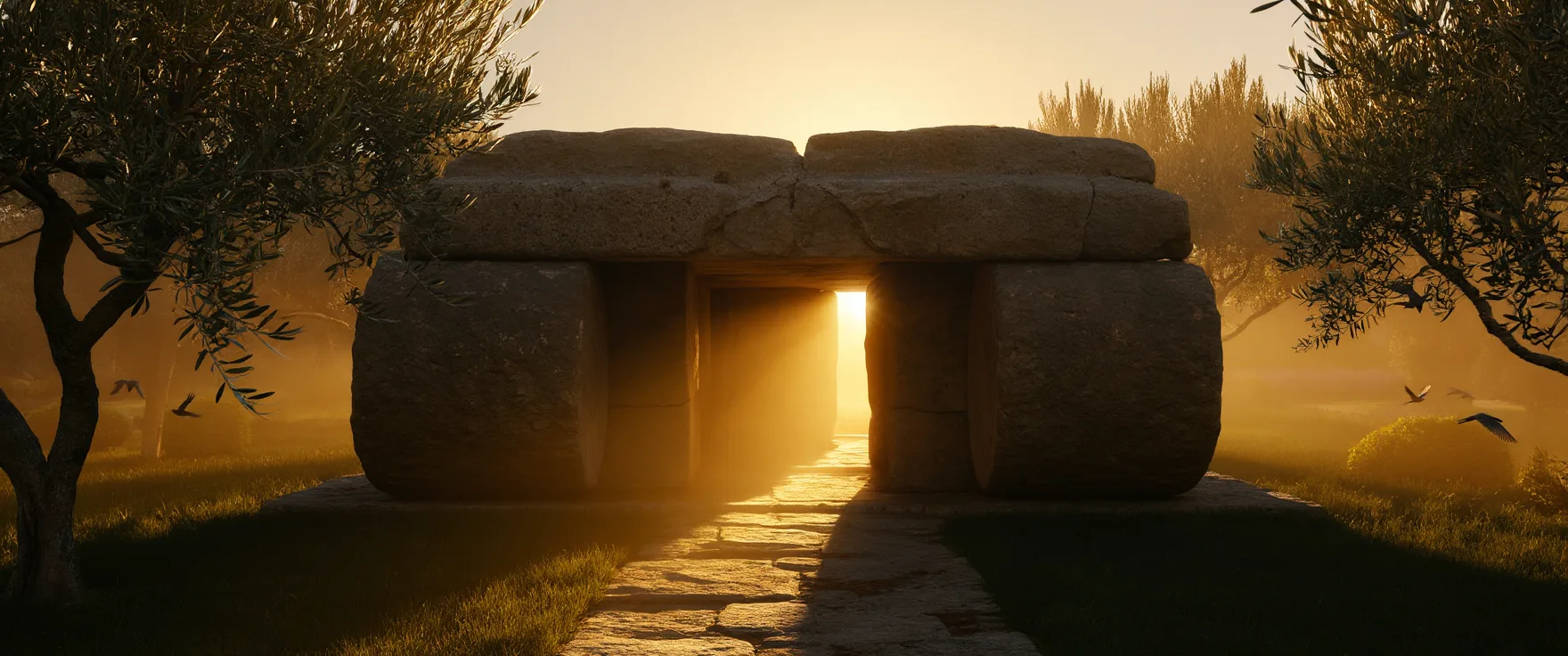
In the ancient world, a woman’s testimony carried almost no weight. The first-century historian Josephus, no friend of Christianity, reported that Jewish law did not even accept women as witnesses in court. Yet all four gospels agree on a strange detail: the first people to find Jesus’s tomb empty were women.
If you were inventing this story, that is the last detail you would invent.
Scholars call this the criterion of embarrassment: a detail so awkward that the author would never have made it up, because it made the story harder to sell. The women at the tomb is one of the most famous embarrassments in ancient literature. Either the gospel writers were telling the truth, or they were sabotaging their own case.
The empty tomb and the women who found it
The outline is simple. Jesus is crucified on a Friday afternoon and buried before sunset in a rock-hewn tomb owned by Joseph of Arimathea, a member of the Jewish council. Early on Sunday morning, a group of women, Mary Magdalene at their head, walk to the tomb to finish preparing the body for burial. They find the stone rolled away and the tomb empty. They run back to tell the disciples, who do not believe them. Luke records that the apostles dismissed the report as “an idle tale.”
Notice what the writers did not do. They did not have Peter discover the tomb, or John, or any man. They handed the discovery to women, the least credible witnesses their culture could offer, and then recorded the male disciples’ skepticism. If the gospels were late, invented propaganda, this is inexplicable. The earliest readers would have laughed at a story that made women the star witnesses.
There is more. The tomb of Joseph of Arimathea was a known, visitable location. In the weeks after the crucifixion, the apostles stood in Jerusalem and proclaimed that this specific tomb was empty, in the city where the authorities had every motive to produce the body and end the movement before it started. Nobody ever produced it. The simplest explanation is that there was no body to produce.
A creed written within a few years
Here is where the evidence gets genuinely hard to dismiss. In 1 Corinthians 15:3-7, Paul writes:
For what I received I passed on to you as of first importance: that Christ died for our sins according to the Scriptures, that he was buried, that he was raised on the third day according to the Scriptures, and that he appeared to Cephas, and then to the Twelve. After that, he appeared to more than five hundred of the brothers and sisters at the same time, most of whom are still living.
Paul wrote that letter around 55 AD. But notice the phrase “what I received.” That is the technical language of oral tradition, the way rabbis handed down teachings. Paul received this creed when he converted, around 33-35 AD, within a few years of the crucifixion itself. Scholars across the spectrum, including skeptics like Gerd Lüdemann and Bart Ehrman, date it to within three to five years of the events. For ancient history, that is astonishingly close.
Think about what that means. The claim “he was raised” was being recited as a fixed formula in Jerusalem while every eyewitness was still alive. Compare the biographies of Alexander the Great, written centuries after his death, which historians accept as broadly historical. The resurrection creed is dramatically closer to its subject. If it had been false, the eyewitnesses could have said so. The creed survived anyway, which tells you something about what the eyewitnesses were saying.
The creed also lists witnesses: Peter, the Twelve, more than five hundred at once, then James, then all the apostles. Paul adds pointedly that most of the five hundred are still alive, so go ask them. Two names in that list deserve attention. James was Jesus’s own brother, a skeptic during his ministry. Paul himself had been a persecutor of the church. Both were transformed by what they claimed to have seen. That brings us to the next line of evidence.
Cowards who became martyrs
Before the crucifixion, the disciples were not brave. When Jesus was arrested, they ran. Peter, the leader, denied knowing him three times to a servant girl and then wept. When Jesus died, the movement should have ended. That is the normal pattern for failed messiahs: the followers slink home, disillusioned, and the sect evaporates within a generation.
Instead, within weeks, these same men were in Jerusalem, the city where Jesus had been executed, proclaiming publicly that he rose from the dead. They kept proclaiming it even as it cost them everything. According to early tradition:
- Peter was crucified upside down in Rome under Nero.
- Paul was beheaded.
- James, the brother of Jesus, was stoned.
- Thomas was martyred in India.
Nearly all of the Twelve died violently, and not one of them is recorded as recanting.
People die for what they believe is true. That proves nothing by itself. What is remarkable here is different: these men died for what they claimed to have seen with their own eyes. They were in a position to know. If the resurrection was a lie, they took the secret to their graves, and in exchange they received torture and execution.
The alternatives, honestly weighed
A skeptic deserves better than a straw man. Here are the three classic alternatives, taken seriously.
Hallucination. Grief-stricken followers imagined the risen Jesus. The problem: hallucinations are private, individual experiences. The creed records group appearances, to twelve men at once and to more than five hundred at once. Mass hallucination on that scale has no parallel in psychology. The appearances were not limited to the grieving either. Paul was an active enemy of the movement. You do not hallucinate someone you are trying to destroy.
Conspiracy. The disciples stole the body and lied about it. The problem: these were terrified men with nothing to gain, and they died for the lie without a single one of them breaking. Conspiracies of twelve unravel in weeks under ordinary pressure. This one held through floggings, imprisonment, and execution.
Swoon. Jesus did not really die; he revived in the tomb. This theory is essentially extinct among scholars, including skeptical ones. Roman crucifixion was designed by professionals to kill reliably, and the soldiers who confirmed the death were experts whose careers depended on it. A man who had been flogged, nailed, and stabbed would not have rolled away a heavy stone and persuaded his disciples he had conquered death. As the nineteenth-century critic David Strauss put it, a half-dead Jesus would have produced a dead movement, not a risen Lord.
None of the alternatives explains the evidence. The empty tomb, the women, the early creed, the transformed disciples, the martyrdoms: they form a cumulative case that has survived two thousand years of hostile scrutiny. The honest conclusion of most historians who engage the evidence is that something happened. The tomb was empty, and the disciples genuinely believed they had seen Jesus alive.
What’s at stake
If the resurrection happened, it is not one miracle among many. It is the claim that the tomb is empty and death itself has been defeated. It means Jesus’s own claims about himself, about God, and about us are true: that God is real, that he loves us, that forgiveness is available, and that death is not the end. The whole of Christian faith rests on this single event.
If the resurrection did not happen, Christianity is a lie built on a corpse, and Paul’s own words apply: “If only for this life we have hope in Christ, we are of all people most to be pitied.”
The evidence does not force belief. Faith remains a step, a trust placed in the person the witnesses describe. But it is a step toward something, not a leap into nothing. The witnesses staked their lives on it, and two thousand years of scrutiny have not buried the claim. The tomb is still empty. The verdict is yours to give.
For a practical companion on studying the Bible with scholarly tools, see Reading Scripture Like a Scholar.
Written by
JellyPuff Media
Editor-in-Chief
Auckland-based publisher producing warm, honest Bible study content for readers everywhere.
Keep reading
Related articles
Prophecies Fulfilled in Jesus: The Bible's Most Checkable Claim
Centuries before Jesus, the Hebrew scriptures describe a suffering servant, a Bethlehem birthplace, and a Messiah's timeline. This is the Bible's most checkable claim, and the debate over it is more interesting than you'd think.

Archaeology and the Bible: Stones That Speak
From the Pool of Siloam to the Pilate Stone — what a century of digging has actually confirmed about the biblical world, and what it hasn't.